Technical skill gets a plane off the ground, but managing cultural gaps is what keeps global operations safe. Breaking down how Cultural Intelligence (CQ) is transforming daily work across the entire aviation industry, from the cockpit to the customer service counter.
Power Distance Index
In high-stakes environment of a commercial cockpit, technical checklists are identical worldwide, but the human dynamics operating them are not. One of the most critical concepts in aviation human factors is the Power Distance Index (PDI)—a metric that measures how much less-powerful members of a culture accept and expect unequal distribution of authority. In a high-PDI cockpit, a junior first officer views the captain not just as a team leader, but as an absolute superior. When an emergency strikes, this invisible cultural hierarchy can create a deadly silence, preventing crucial safety feedback from reaching the person flying the aircraft.
“Captainitis” Phenomenon
Aviation history has shown that when a captain makes an operational error, a junior pilot with low Cultural Intelligence (CQ) may experience “Captainitis”—the psychological hesitation to correct a senior officer’s mistake. Instead of stating a hazard clearly, the first officer might use overly polite, indirect hints, hoping the captain catches the error. A culturally intelligent captain recognizes this dynamic instantly. By actively applying CQ, the captain modifies their leadership style, flattens the cockpit hierarchy during the pre-flight briefing, and explicitly invites the first officer to challenge any decision, ensuring that critical data is never withheld due to social deference.
Hinting into assertive action
To bridge these cultural gaps, modern Crew Resource Management (CRM) relies heavily on behavioral CQ to implement standardized communication tools, such as the Pace Non-Standard Communication Model. This framework gives junior pilots a structured, step-by-step pathway to escalate their communication from a simple probe to an absolute command when safety margins are threatened:
- Probe: “Captain, do you see that storm cell on the radar?”
- Alert: “Captain, we are heading directly into heavy turbulence.”
- Correct: “We need to turn left fifteen degrees now to avoid the cell.”
- Emergency: “I have control of the aircraft.”
By training crews to recognize their own cultural PDI tendencies, pilots learn to bypass emotional hesitation and switch to this objective, assertive language smoothly.
Simulator Training
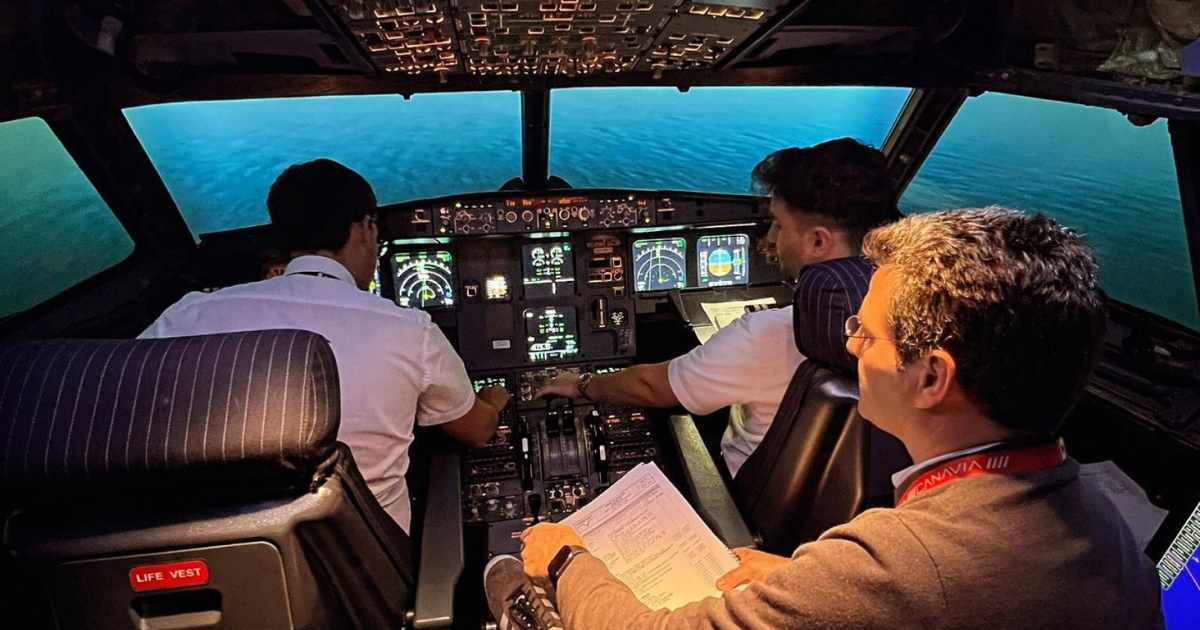
This deep psychological integration is why advanced flight training centers no longer treat cultural intelligence as a theoretical classroom lecture. Modern Line-Oriented Flight Training (LOFT) sessions inside full-flight simulators purposefully pair crews from contrasting PDI backgrounds and introduce complex, fast-moving threats. Pilots are forced to navigate both the mechanical malfunction and their own cultural communication biases in real-time. Developing this high level of cultural flexibility during initial training transforms CQ from an abstract concept into a practical, life-saving flight deck tool, proving that the safest captains are those who can read their crew just as accurately as their instruments.